![]() |
Melissa
Kaplan's |
Lyme
Disease
An
exercise in nailing Jello® to a wall.
| CND
Info Topics About
Melissa Kaplan |
Scarily enough, there are still
health care providers out there who do not believe Lyme Disease is a real disease.
Like those with CFS, FM and MCS, people with Lyme are told they are "just
depressed" or "trying to get attention" or that it is "all
in your head" (to be fair, since the spirochetes or their toxins can cross
the blood brain barrier, it is in your head, though this is not quite what these
doctors were implying...). If this typifies the response you got from your doctor,
it's time to find a new one. Of course, most doctors rely on what the CDC and their state and county departments of health tell them. Anyone who has watched the CDC in action over the past several years (okay, decades) know that whatever it is they are doing, it has little to do with disease control and prevention, especially when it comes to organisms as changeable and adaptive as parasites. The CDC--and insurance companies--take their cue on what Lyme disease is and how to treat it from the ISDA, a group of self-serving physicians who selectively review only that literature which agrees with their premise: that LD is easily and quickly treated, and if you're still sick, then you're clearly mentally ill. Physician Joseph Schaller discusses the situation in a letter to the editor of The Scientist in February 2007, in response to the dismissive article, State official subpoenas infectious disease group. From January 1 through May 10, 2003, there were 1727 cases of Lyme disease reported to the CDC. It is estimated that only one out of every 10 cases of Lyme disease is reported to the CDC. --Lyme Disease Foundation "...Lyme disease has become a permanent part of America's public health landscape. It provides a warning and example of how an apparent state or regionally-centered problem can grow to become a national problem. Instead of implementing a proactive, nationwide animal-borne disease management strategy, the public health response to Lyme disease was left to evolve as the disease spread across country." (From Animal-Borne Epidemics Out Of Control: Threatening the Nation's Health, published by Trust for America's Health)
| ||||||||||||||||||||||
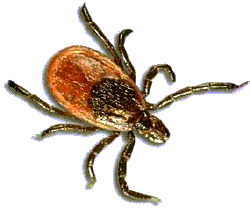
| In a recent talk to a group of tickborne infection (TBI) patients, my TBI doctor related what he tells physicians who are trying to understand why Borrelia infections are so difficult to nail down and treat. The problem, he said, is in thinking that Borrelia is as simple an organism as that other too well known spirochete, syphilis (Treponema pallidium). Syphilis is easy to diagnose and easy to treat when caught in the early stages. But just because it is a spirochete doesn't mean that Borrelia acts like T. pallidium, rather, is is more like tuberculosis in that it can lay dormant for years in to body, and takes prolonged courses of antibiotics once it does flare. In addition, Borrelia has many more genes than does T. pallidium that are dedicated to evading detection by tests and the immune system, enabling the dozens of known subspecies/strains of Borrelia to protect itself, even when finally treated appropriately. This isn't news, by the way, but most physicians, state medical associations, university hospitals, and public health agencies prefer to keep their heads buried firmly in the sand than admit that Babesia, Bartonella, Borrelia, and Ehrlichia are far more complex than originally thought, making them extremely difficult detect and treat, especially in people who have been sick and improperly diagnosed and/or treated for years. It is apparent that their egos are more important that the public's welfare, given the many ways these organizations and agencies, charged with informing and protecting the public's health, continue to fail to do so.
Message
from Lyme The background to the discovery of Lyme disease teaches a salutary lesson. The symptoms and signs of this disease had been observed by doctors for a century, particularly in the Scandinavian countries, without anybody being able to draw the right conclusions. The first patients were identified in the USA by their relatives or by themselves. Recognition of their plight by the medical profession was chiefly due to the patients' tenacity. We must remember to pay attention to what patients tell us; they may often be right, even when they seem to be wrong. Where fact and theory are incompatible, it is theory, not fact, that needs to be amended. In all likelihood, we all from time to time observe disorders in our patients that are inconsistent with established scientific models, but which we nevertheless attempt to squeeze into these models. Such an approach is not uncommon in the history of medicine. The message from Lyme calls for humility and reflexion.
Waste
Not, Want Not
Not only are deer NOT the primary vectors of the ticks infected with Bb, the organism that causes Lyme disease, and the gang of other parasites living in the same ticks (Babesia, Bartonella, and Ehrlichia), but the more tick hosts you remove from the environment, the more those ticks are going to feed on pet dogs, cats, and humans. True, this might be the ramblings of a brain gone bad on Borrelia and Babesia, so don't take my word for it. Read: The ecology of infectious disease: Effects of host diversity and community composition on Lyme disease risk, Kathleen LoGiudice, et al. Proceedings of the National Academy of Sciences, January 21, 2003, 100(2):567-571
Passive
Advocacy
Glossary
for this and other TBD Sites
A
Note To Keep In Mind... Index to Sections:
DIAGNOSIS Note that there are other organisms besides Borrelia that live in ticks and can be transmitted to humans through bites, causing other tick-borne illnesses (TBI). The most common ones known to date (new ones continue to be identified as time goes on) include Babesia (babesiosis), Erhlichia (erhlichiosis) and Bartonella (bartonellosis). The symptoms of other TBI often overlap those of Lyme and, like Lyme, are just as difficult, if not more so, to diagnose and treat. When
to Suspect Lyme Disease Jemsek: Lyme Disease in the Carolinas (worth reading even if you live outside the Carolinas) Clinical
implications of delayed growth of the Lyme borreliosis spirochete, Borrelia
burgdorferi. Everyday Observations of Lyme, Biotoxins and Inflammation: Signs Commonly Missed A Plague of Ignorance Regarding the Ignorance of a Plague
Important
Articles for Patients, Families, and Physicians The
Treatment of Lyme Disease: a Medicolegal Assessment (Johnson/Stricker)
Evidence-Based Treatment
Guidelines for the Management of Lyme Disease Advanced
Topics in Lyme Disease: Diagnostic Hints & Treatment Guidelines Controversies
in Diagnosis and Treatment Generalizability
in Two Clinical Trials of Lyme Disease Everyday
Observations of Lyme, Biotoxins and Inflammation: Signs Commonly Missed What You Need To Know About ILADS & Lyme Disease (PDF booklet) What Psychiatrists Should Know about Lyme Disease (PDF booklet) ILADS Demands Retraction of New IDSA Guidelines for Treatment of Lyme Disease LYME DISEASE IN CALIFORNIA (University of California Integrated Pest Management)
TESTING There are 300+ known strains of Bb around the world, and half dozen known types. When you add the number of strains + types + hundreds of different shifting OSP combinations + the "regular" forms + L-forms (even more shapes and forms that each Bb can adopt throughout its life), there is as yet no existing test that can look for all of these at one time. Or 6 times. Or however many times. So, one may meet all the clinical criteria for Lyme yet keep coming up with negative test results. The test alone cannot be used to determine whether or not the patient has Lyme. Testing for Lyme is like looking for a person in a crowd, using a photograph that was taken 30 years ago. The face today may be framed by different color hair, different features due to plastic surgery, more or less weight, glasses or color-altering contacts, etc. The skin may even be a different color. Even if you know for sure that the person you are seeking is in a specific crowd of people, the changes intentionally made and that time has wrought can make it difficult if not impossible to find the person the first, second, third, etc., time you look at each face in that crowd. Face-recognition software may help you narrow down the possibilities, but it won't necessarily come up with only that person.
Ticks and mosquitoes can be carrying hundreds of different types of parasites. When they bite us to feed, many of those parasite species enter our bodies, too. That's why people with bug-borne parasites frequently end up with more than one disease (Lyme + babesiosis, for example, or Lyme + ehrlichiosis). In the case of tick bites (at least in the U.S.), that is why these Ehrlichia and Babesia are generally tested for at the same time as testing is being done for Lyme: Ehrlichia and Babesia are found in the same areas and same hosts (and same arthropods) as Bb. Some of the incoming parasites are successfully conquered shortly after entering our skin or blood stream; others succumb to macrophages or antibodies made to attack them. Those parasites who escape may settle down to a quiet, restrained life, invoking no illness or adverse changes that we detect, and may remain that way for years before acting up, or forever. Some make us sick sooner rather than later, with some people getting sicker than others. Just in case you thought this was going to be easy... TESTING
LABS In late 2005, the New York Times knowingly published an inaccurate article about the accuracy of IGeneX's tests, including saying it had failed certification. In fact, IGeneX was in the midst of a routine recertification, something that all labs are required to do, and, as always, it passed, both in New York and California, the two most difficult states in which to get certified. If your doctor or family tells you IGeneX is 'bad', print out the the CLIA 2005-2007 certification and tell them to go do the research that the New York Times refused to do--and ignored when the certification was sent to them. Best tests:
Worthless Tests:
Related
Articles Relevance
and Biopsying the Erythema migrans
if you do have such a rash, get your doctor to have a biopsy and culture done: even if you are seronegative at that time (have negative results on the ELISA, EIA, and WB), the Borrelia spirochetes can be found in the biopsied skin.
TREATMENT
PROTOCOLS
Naturopathic/Non-Prescription
Drug Treatment Protocols There can also be some unintended consequences: While on IV Colloidal Silver, after my initial herxing, I started feeling better...until one day, I got slammed with Babesia symptoms. Apparently, the artemisinin I'd been on the year before, which had reduced my Babesia microti down to "non-infective" levels, did not eradicate it. Some other organism or two or three were helping my body keep down the Babesia population left after I went off the artemisin, organisms that were killed off by the silver, resulting in a major Babesia population. Fortunately, my physician had just returned from a Lyme conferenced, wherein he learned that Babesia is far more prevalent in the Lyme patient population (40% or more), and is far more difficult to get rid of, has a cyst form requiring the addition of a third antibiotic, and the tests are, like tests for Borrelia burgdorferi, returning high rates of false negatives because acute illness happens at ratios far less than the test sensitivity levels. [Note that there are tests for only two of the 13 known Babesia species, so people infected with the other 11 species will never test positive, no matter how sick they are.) Samento
(TOA-Free Cat's Claw [Uncaria tomentosa]) & Lyme Disease: I
also took the liquid Samento, working up from 1 drop once a day to 5 drops three
times a day. During that time, I experienced greatly elevated overall inflammation.
On my doctor's recommendation, I started taking a curcumoid (derived from tumeric)
product (Pure Encapsulation's Curcumin 97), one capsule 3 times a day. On the
sixth day, someone asked me how the inflammation was - and I realized that the
Samento-induced inflammation was completely gone. New
Uses for Old Drugs BORRELIA
RESISTANT TO TREATMENT
PERSISTENCE
OF BORRELIA AND OTHER TBI
The
fate of B. burgdorferi, the agent for Lyme disease, in mouse macrophages.
Destruction, survival, recovery.
ARTICLES International
Lyme & Associated Diseases Society (ILADS) Responds to Poor Research Supported
by AMA/CDC
The
Emerging Science of Lyme
Emerging
Testing and Diagnosis
Other
Interesting Articles
Post-Treatment
Sequelae
THE
POLITICS OF LYME
Other
Issues in Lyme Endometriosis & Lyme: Is there a connection?
...Mainstream
Media
...Lyme's
Spirochetal Cousin, Syphilis
...Co-Infections
Video
Blood Supply May Be Source
of Lyme Disease Infection, KTVU News, San Francisco, 7/2004 video
clip Lyme Disease Panel
Discussion (August 14, 2004)
LYME
DISEASE ORGANIZATION SITES Summer
2004, Issue #37/38: The Patient Issue In fact, order several copies of each, and help educate your family, friends, support groups, and physicians. Canadian
Lyme Disease Foundation
EXCELLENT
PATIENT SITES
Informative
Physician Sites
LYME
& RELATED COINFECTIONS EMAIL LISTS & FORUMS
Recommended
Reading
Tick
Acquisition
Important
To Note: You'd think they would learn from the CDC's mistakes with AIDS, CFS, and WNV, but I guess some people (and organizations) have to do it the hard way... Unfortunately, it's patients, not the federal agencies, who suffer. You will need to take the CDC and state's department of health tickborne diseases people with a grain of salt, as the CDC/NIH has historically done lousy job developing tests, assessing test results, and believing patients are really sick. If you still aren't sure what I'm talking about, please read Osler's Web (Hillary Johnson), and And the Band Played On: Politics, People, and the AIDS Epidemic, by Randy Shilts. In the not too near future, someone will write similar books on Lyme, West Nile Virus, and anthrax. You should also understand that, while the FDA is nominally in charge of the nation's blood and organ banks, the FDA takes their lead from the CDC in terms of screening for diseases that can be transmitted through whole blood, organs, and blood products. See also Non-Tick Transmission of Lyme and Other Tick-Borne Infections.
| |||||||||||||||||||||||
http://www.anapsid.org/lyme/index.html
